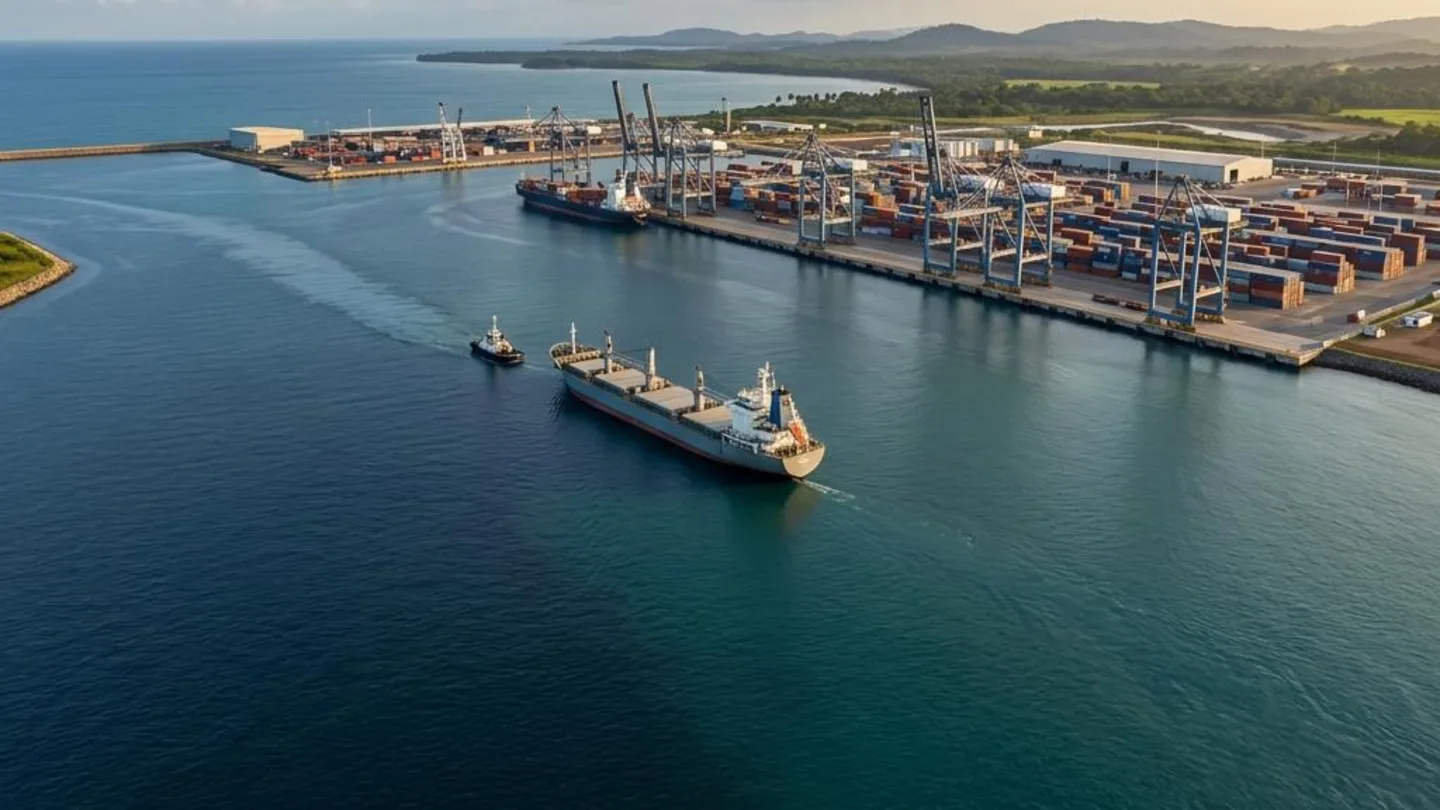
A ship-to-ship (STS) transfer framework is the set of rules, approvals, procedures and checks that lets a coastal state or port authority allow cargo transfers between ships while keeping pollution, collision and security risks under control. Without one, STS operations happen anyway, often unseen and unmanaged. Maximum Services Sarl helps maritime administrations, port authorities and terminal operators in the Gulf of Guinea design that framework, assess STS risks and train the people who run the operations.
Why STS transfers need a framework in the Gulf of Guinea
STS transfers are a normal part of the oil and gas trade. They let large tankers lighter cargo into smaller ships, serve ports with draught limits and supply offshore installations. They also carry real risks: collision during approach and mooring, hose failure and oil spills, fire, and personnel injury on transfer.
The Gulf of Guinea adds two more concerns. Traffic is growing, and weak oversight attracts operators who want to hide where cargo comes from. S&P Global reported in October 2024 that the region had become a hotspot for "shadow fleet" tankers, with 91 STS transactions between tankers above 27,000 DWT recorded in September 2024, up 65% year on year. A clear framework with designated areas, prior notification and monitoring protects the coastal state's environment, its revenue and its reputation.
The regulatory basis
| Instrument | What it requires |
|---|---|
| MARPOL Annex I, Chapter 8 (Regulations 40–42) | Oil tankers of 150 GT and above engaged in STS transfer of oil cargo must carry a flag-approved STS Operations Plan and follow it. In force since 1 January 2011. |
| MARPOL Annex I, Regulation 42 | Advance notification to the coastal state when STS operations take place in its territorial sea or EEZ. |
| CDI/ICS/OCIMF/SIGTTO Ship to Ship Transfer Guide for Petroleum, Chemicals and Liquefied Gases | Industry best practice for planning, compatibility, mooring, fendering, communications and checklists. Second edition published October 2025. |
| IMO Manual on Oil Pollution, Section I, Prevention | Guidance on preventing pollution during transfers. |
| National maritime code and port regulations | Designated STS areas, permits, fees, inspections and reporting. |
MARPOL Chapter 8 regulates the ships. It does not tell a coastal state where STS may happen, who may supervise it or how the authority checks compliance. That is the gap a national or port-level framework fills.
What a complete STS framework contains
- Legal and institutional basis. Who authorises STS: the maritime administration, the port authority or both. Which texts give them that power.
- Designated STS areas. Locations chosen by risk assessment, away from sensitive habitats, fishing grounds, traffic lanes and subsea cables, with depth, holding ground and metocean limits.
- Authorisation and notification procedure. Application forms, required documents (STS plans, P&I cover, POAC qualifications), the 48-hour notification and approval timelines.
- Approved STS service providers. Criteria for companies, mooring masters and equipment (fenders, hoses, support craft).
- Operational limits. Wind, sea state, visibility and daylight rules, and stop-work criteria.
- Pollution preparedness. Tier 1 response equipment on site, links to the national oil spill contingency plan.
- Monitoring and enforcement. AIS and VTS monitoring, inspections, incident reporting and sanctions.
- Fees and records. A transparent tariff and a register of all operations.
STS risk assessment: our method
We assess STS risk at two levels. At area level, we use a SIRA-style workshop to compare candidate STS locations and set operating limits. At operation level, we review each type of transfer (crude lightering, product, LPG) with a HAZID covering approach and berthing, mooring and fendering, hose connection, cargo transfer, unmooring and emergency scenarios.
The assessment checks, for example, fender and hose inspection dates, mooring masters' documented experience, agreed stop-work criteria and how close response equipment is to the operation. Each gap found goes into a risk register with a control, an owner and a deadline.
Training and competence
The framework only works if the people running it are competent. Through Maximum Services and our partner institute SQMI, we deliver STS awareness training for authority staff, mooring master and POAC development programmes, and emergency drills that test the full chain from ship to shore.
Frequently asked questions
Who needs an STS Operations Plan?
Under MARPOL Annex I, Regulation 41, any oil tanker of 150 GT or more that transfers oil cargo to or from another tanker at sea must carry an STS Operations Plan approved by its flag administration. The plan must be written in the ship's working language. Bunkering operations are excluded.
What is a POAC in STS operations?
The Person in Overall Advisory Control (POAC) is the qualified person, often a mooring master, who advises both masters and coordinates the STS operation. The masters keep their own command responsibility. The industry STS guide sets out the training and experience a POAC should have.
Can a port authority designate its own STS area?
Yes, where national law gives it the power, usually together with the maritime administration. The choice of area should rest on a documented risk assessment covering depth, weather, traffic, environmental sensitivity and response capability. Maximum Services prepares that assessment and the supporting regulations.
How long does it take to develop an STS framework?
A basic framework with designated areas, an authorisation procedure and checklists can be drafted in about three to four months. Adoption into national regulation depends on the legislative process and can take longer.
Talk to our STS team
Whether you are a maritime administration writing STS rules, a port authority approving operations or an operator preparing for an inspection, Maximum Services Sarl can help.