
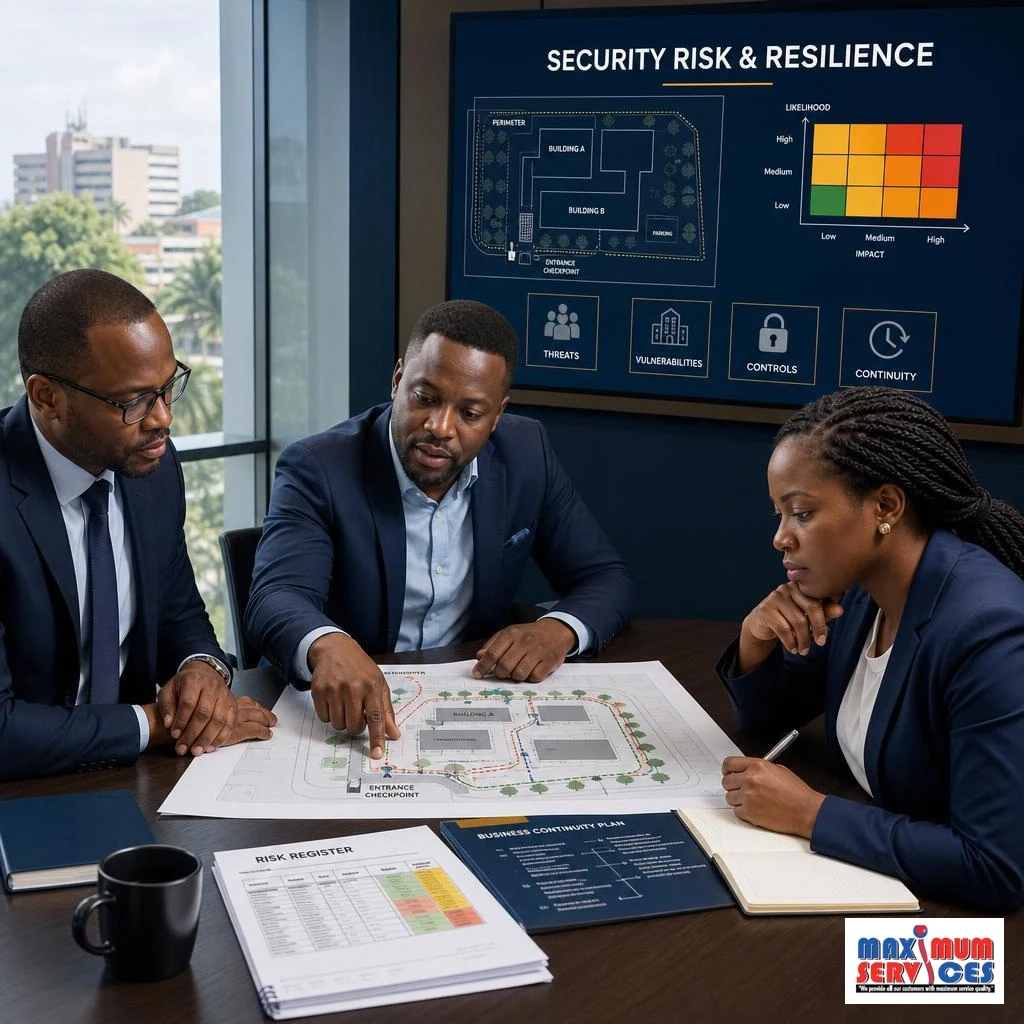
A corporate security vulnerability risk assessment is a structured review of the threats your company faces, the weaknesses those threats could exploit, and the harm to people, assets, operations and reputation if they succeed. It ends with a prioritised, costed plan of security measures that matches your real risk, so your security budget goes where it protects the most. Maximum Services Sarl offers this service to head offices, industrial sites, warehouses, fuel depots, ports and terminals, banks and retail networks, hotels and project camps in Cameroon and the CEMAC region.
Why companies need a security vulnerability risk assessment
Companies in Central and West Africa face theft of fuel, stock and cargo, intrusion and vandalism, fraud and insider collusion, armed robbery, kidnapping risk for staff and executives on the move, and disruption from civil unrest. Many respond after an incident by adding guards or cameras. Without an assessment, those measures often miss the real weakness: an unlit fence line, a gate procedure nobody follows, a key cabinet anyone can open, or a stores clerk whose access is never checked.
A security vulnerability risk assessment gives management:
- A clear picture of risk. Which assets matter most, who might target them, how, and what it would cost the business.
- Value for money. Security spending directed at the highest risks instead of spread evenly across the site.
- Better contracts. Clear performance requirements for your guarding company and security suppliers.
- Evidence. A documented basis for the board, insurers, lenders, clients and regulators, including ISPS port facility security assessments where they apply.
The standards behind our method
| Reference | How we use it |
|---|---|
| ASIS Security Risk Assessment Standard (SRA-2024) | Main method for security risk assessment; it replaced the ANSI/ASIS/RIMS RA.1-2015 standard |
| ISO 31000:2018, Risk management — Guidelines | Overall risk-management framework and risk criteria |
| ISO 22341:2021, Crime prevention through environmental design (CPTED) | Using layout, lighting, landscaping and sightlines to deter crime |
| ISO 28000:2022, Security and resilience — Security management systems | Integrating security into a management system, including the supply chain |
| API RP 780, Security Risk Assessment Methodology | Petroleum and petrochemical facilities, fuel depots and terminals |
| ISPS Code (SOLAS Chapter XI-2) | Port facility security assessments and plans |
| Voluntary Principles on Security and Human Rights | Security arrangements for extractive and energy projects, including the use of public and private security forces |
What we assess
Our assessment covers every layer of corporate security:
- Perimeter and site layout. Fences, walls, gates, clear zones, lighting, vegetation and blind spots.
- Access control. People, vehicles and goods; visitors, contractors and deliveries; badges, registers and key control.
- Electronic security. CCTV coverage and recording, intrusion alarms, the control room and the alarm response chain.
- Guard force. Organisation, post orders, patrols, supervision, training, equipment, response times and the guarding contract.
- Assets and cash. Stores, warehouses, fuel, high-value equipment, cash handling and transfers.
- People security. Executive protection, staff travel and journey management, and residences where relevant.
- Insider threat. Pre-employment checks, separation of duties, stock reconciliation and reporting channels.
- Information security interfaces. Protection of the control room, access-control systems, CCTV networks and sensitive documents.
- Security incident response. Procedures for intrusion, armed robbery, bomb threat, kidnapping and civil unrest, and links with the police and gendarmerie.
Our security vulnerability risk assessment process
- Scoping meeting. Agree the sites, assets, concerns and confidentiality arrangements with management.
- Asset characterisation. List and rank what must be protected: people, critical equipment, stock and cargo, information, reputation and business continuity.
- Threat assessment. Assess who might cause harm and how capable and motivated they are: opportunist thieves, organised criminal groups, insiders, activists, armed groups. Sources include your incident history, local information, contacts with the security services and open sources.
- Vulnerability survey. Inspect the site by day and by night, observe how procedures work in practice, interview managers, supervisors and guards, and test selected controls discreetly.
- Risk analysis. For each threat scenario, rate likelihood and impact on a security risk matrix and record the vulnerabilities that make it possible.
- Countermeasures. Recommend measures using the layered deter, detect, delay, respond principle, from low-cost fixes (procedures, lighting, vegetation clearing, key control) to capital investments (barriers, access control systems, CCTV upgrades).
- Report and briefing. Deliver a confidential report and present the findings and priorities to management.
What you receive
| Deliverable | Purpose |
|---|---|
| Confidential security vulnerability risk assessment report | Full analysis of assets, threats, vulnerabilities and risks |
| Security risk register | Ranked scenarios with existing and proposed controls |
| Site security drawings | Perimeter, lighting, CCTV and access-control layout with gaps marked |
| Prioritised, costed action plan | Quick wins and investments, with owners, indicative costs and timeline |
| Guard force and security contract review | Post orders, staffing, supervision and performance criteria for your provider |
| Security incident response procedures | Clear actions for the main security scenarios |
| Management briefing | A short presentation for the board or general management |
All findings are treated as strictly confidential and shared only with the people you name.
After the assessment
Security improves only when the plan is carried out. On request, Maximum Services Sarl can support you after the assessment by:
- drafting security procedures and post orders;
- writing specifications for guarding contracts and security equipment tenders;
- training security supervisors and guards, with our partner institute SQMI;
- carrying out a follow-up review to check that measures are in place and working.
Why choose Maximum Services Sarl
Our approach combines security risk assessment with safety and risk-management expertise. Our lead consultant holds the NEBOSH Diploma and an MBA, and our method follows recognised international standards: ASIS, ISO, API and the ISPS Code. We know the operating environment of companies, ports, terminals and industrial sites in Central and West Africa. We work in French and English, and we treat every assignment with strict confidentiality.
Frequently asked questions
What is the difference between a security vulnerability risk assessment and a security audit?
A security audit checks whether your existing measures and procedures are applied as written. A security vulnerability risk assessment goes further. It starts from your assets and the threats against them, finds the weaknesses an attacker could exploit, and recommends the measures you actually need. Companies often do the assessment first and audits afterwards.
How often should a company carry out a security vulnerability risk assessment?
We recommend a full assessment every two to three years. Review it sooner when the threat level changes, after a serious incident, or when you open a new site, change the layout or start a new activity. Port facilities follow the review cycle set by their ISPS approval.
How long does the assessment take?
For a single site of medium size, allow about two to four weeks from the start of fieldwork to the final report. That includes day and night surveys, interviews and the management briefing. Multi-site companies or high-risk operations take longer.
Will the assessment disrupt our operations?
No. Surveys and interviews are planned with your security and operations managers. Some checks, such as gate procedures or night patrols, are done discreetly so they show how security really works.
Can you review our guarding company's performance?
Yes. We review post orders, staffing levels, supervision, training, equipment and response times against your risks. We then recommend clear performance requirements to include in the guarding contract, so you can measure the service you pay for.
Do you also assess cyber security?
Our focus is physical, personnel and operational security. We review the points where physical and information security meet, such as the control room, access-control systems, CCTV networks and sensitive documents. We can work alongside your IT security provider for a full assessment.
Request a confidential quote
Know your real security risks before someone else finds them. Contact Maximum Services Sarl in Douala for a confidential discussion and a proposal in English or French.