
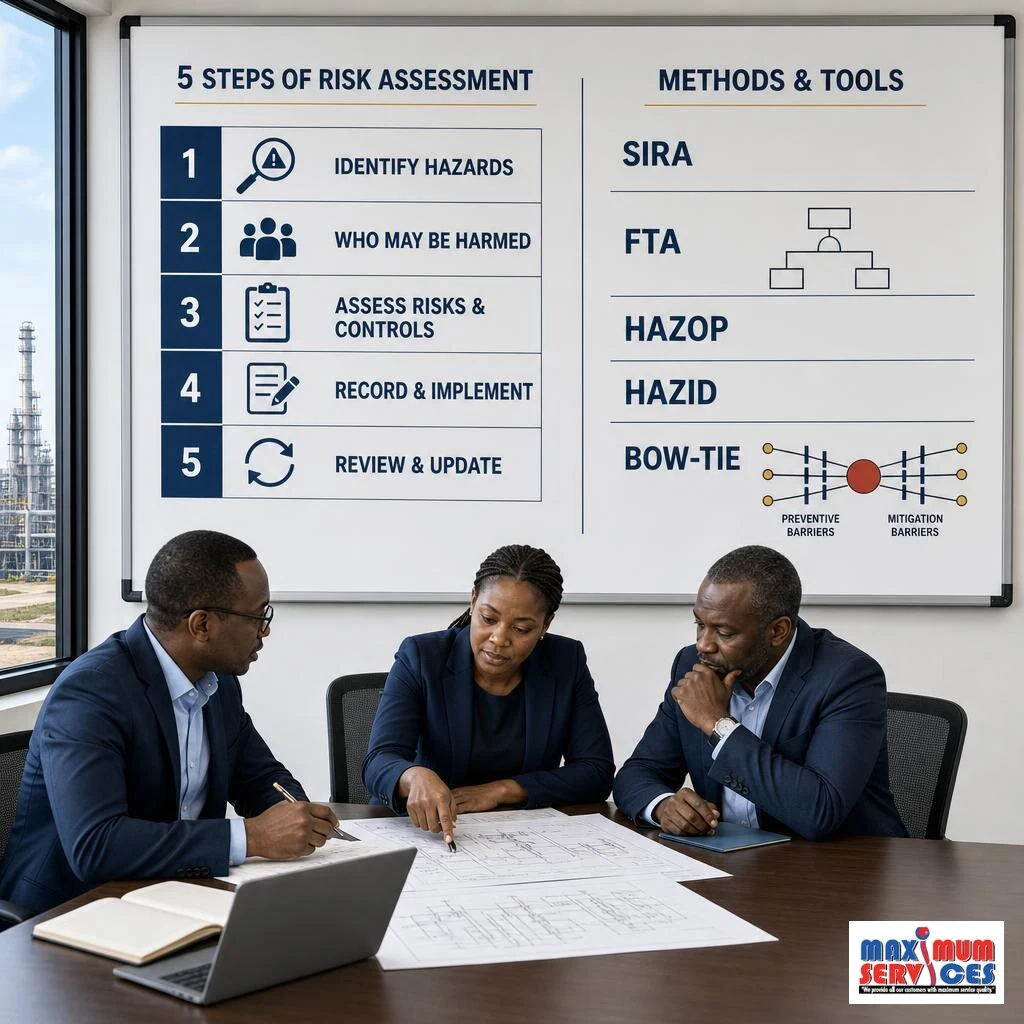
Process safety is the discipline that prevents fires, explosions and toxic releases in plants that handle hazardous substances and energy. It relies on structured studies that find what could go wrong in a process, how bad it could be, and which barriers must be in place to stop it. Maximum Services Sarl offers a full range of risk and process safety studies for industrial complexes in Cameroon and the CEMAC region: HAZID, HAZOP, bow-tie analysis, layer of protection analysis (LOPA), SIL determination, regulatory hazard studies and process safety audits. We support refineries, fuel and LPG depots, gas plants, chemical and fertiliser plants, cement works, breweries, power stations, mineral processing plants and port tank terminals.
Why process safety matters
A single loss of containment in a process plant can cause multiple fatalities, destroy assets, pollute the environment and stop production for months. Occupational safety programmes reduce slips, falls and injuries, but they do not prevent major accidents on their own. Major accident hazards need their own systematic studies and barriers.
In Cameroon, the legal framework is clear. Law No. 98/015 of 14 July 1998 governs establishments classified as dangerous, unhealthy or inconvenient, and requires the operator of a first-class classified establishment to carry out a hazard study (étude des dangers) before the site opens. Decree No. 99/818/PM of 9 November 1999 sets the conditions for setting up and operating these establishments. Law No. 98/020 of 24 December 1998 governs gas and steam pressure equipment, and the framework law on environmental management (Law No. 96/12 of 5 August 1996) requires environmental impact assessment for projects that can harm the environment.
Lenders, insurers, licensors and international partners also expect recognised process hazard analysis methods. Internationally, references such as the United States OSHA Process Safety Management standard and the European Seveso III Directive set the benchmark that many groups apply worldwide.
The standards and guidance we apply
| Reference | How we use it |
|---|---|
| IEC 61882:2016, Hazard and operability studies (HAZOP) — Application guide | Method for HAZOP workshops: nodes, design intent, guide words, deviations, causes, consequences, safeguards |
| IEC 31010:2019, Risk assessment techniques | Choice of technique for each question: HAZID, What-if, FMEA, fault tree, event tree, bow-tie |
| ISO 17776:2016, Major accident hazard management during design | Hazard identification and risk assessment for petroleum and gas installations |
| IEC 61511 and IEC 61508, Functional safety | Safety instrumented functions, SIL determination and the safety lifecycle |
| CCPS guidelines on LOPA and Risk Based Process Safety | Layer of protection analysis and the elements of a process safety management system |
| ISO 31000:2018, Risk management — Guidelines | Risk criteria and integration into company risk management |
| Law 98/015, Decree 99/818/PM and Law 98/020 (Cameroon) | Hazard studies for classified establishments and pressure equipment requirements |
Our risk and process safety studies
| Study | When it is used | What it answers |
|---|---|---|
| HAZID (hazard identification) | Concept and early design, new sites, major modifications, existing facilities | What major hazards exist on the site and in the layout, and which need detailed study? |
| HAZOP (hazard and operability study) | Detailed design, before start-up, periodic revalidation, modifications | How can the process deviate from its design intent, what would happen, and are safeguards enough? |
| What-if and checklist reviews | Simpler units, utilities, procedures, small changes | What could go wrong with this activity, and is it controlled? |
| Bow-tie analysis | Major accident scenarios, safety cases, barrier management | Which threats lead to the top event, which consequences follow, and which barriers prevent or mitigate them? |
| LOPA (layer of protection analysis) | High-consequence HAZOP scenarios | Are the independent protection layers enough to meet the risk target, or is more risk reduction needed? |
| SIL determination | Scenarios relying on safety instrumented functions | What safety integrity level does each safety instrumented function need? |
| FMEA, fault tree and event tree analysis | Critical equipment and complex failure scenarios | How do components fail, and how do failures combine into an accident? |
| Hazard study (étude des dangers) | Authorisation of classified establishments in Cameroon | The regulatory study required before a first-class classified establishment opens |
| Consequence modelling and QRA [VERIFY: confirm software and capability] | Siting, layout, land-use planning | How far would a fire, explosion or toxic cloud reach, and what is the risk to people? |
| Pre-start-up safety review (PSSR) | Before commissioning new or modified plant | Is the plant built as designed, are HAZOP actions closed, and are people and procedures ready? |
| Process safety audit and gap analysis | Existing operations | How strong is your process safety management system against good practice? |
Process safety across the plant lifecycle
- Concept and feasibility. HAZID and early layout review, when design changes are cheapest.
- Front-end and detailed engineering. HAZOP on piping and instrumentation diagrams, LOPA and SIL determination for critical scenarios, bow-tie analysis for major accident hazards.
- Construction and commissioning. Pre-start-up safety review and closure of study actions.
- Operation. Periodic HAZOP revalidation, usually every five years, barrier health reviews and process safety audits.
- Modifications. Management of change reviews proportionate to the change, from a checklist to a full HAZOP.
How we run HAZID and HAZOP workshops
- Independent, experienced facilitation. A facilitator who leads the method and challenges the team, with a dedicated scribe recording every discussion.
- The right team. Process, operations, maintenance, instrumentation, mechanical and HSE representatives from your side, and the designer or licensor when relevant.
- Prepared in advance. Up-to-date P&IDs, process flow diagrams, cause and effect charts, operating procedures and incident history are collected and nodes defined before the workshop.
- Clear recording. Worksheets show each deviation, cause, consequence, existing safeguard, risk ranking and recommendation.
- Actionable recommendations. Every recommendation has an owner and a target date, and is tracked until closed.
- Bilingual. Workshops and reports in French or English, or mixed, to suit your team.
What you receive
| Deliverable | Purpose |
|---|---|
| Study report (HAZID, HAZOP, LOPA, bow-tie or SIL) | Full record of method, team, assumptions, findings and recommendations |
| Worksheets and risk register | Traceable record of every scenario and its safeguards |
| Bow-tie diagrams and barrier register | Visual barrier management for major accident hazards |
| SIL determination report | Required integrity level for each safety instrumented function |
| Recommendations and action tracker | Owners, priorities and target dates until closure |
| Regulatory hazard study (étude des dangers) | Document for the authorisation file of a classified establishment |
| Management presentation | Key risks, priorities and decisions for senior management |
Why choose Maximum Services Sarl
Our lead consultant holds the NEBOSH Diploma, the NEBOSH Technical Certificate in Oil and Gas Operational Safety and an MBA, and is a NEBOSH assessor. Our studies follow recognised international standards (IEC 61882, IEC 31010, IEC 61511, ISO 17776) and CCPS good practice, and they are adapted to Cameroonian regulation. We know the operating environment of terminals, depots, ports and industrial sites in Central and West Africa, including marine transfer and storage operations. We work in French and English, and through our partner institute SQMI we can train your teams in process safety awareness and risk assessment.
Frequently asked questions
What is the difference between HAZID and HAZOP?
HAZID is a broad, early review that identifies the major hazards of a site or project, such as fire, explosion, toxic release, dropped objects or external threats. HAZOP is a detailed, systematic study of the process design, section by section, using guide words to find deviations from design intent. HAZID usually comes first, and HAZOP follows once P&IDs are available.
What is a bow-tie analysis?
A bow-tie is a diagram that places a major accident event, such as a loss of containment, at the centre. Threats that can cause it sit on the left with their prevention barriers, and consequences sit on the right with their mitigation barriers. It makes barrier management easy to understand and is widely used for major accident hazard management and safety cases.
What are LOPA and SIL, and when are they needed?
LOPA checks whether the independent protection layers for a high-consequence scenario reduce the risk enough to meet the company's risk target. When a safety instrumented function is needed to close the gap, SIL determination sets its required safety integrity level under IEC 61511. Both usually follow a HAZOP that identified severe scenarios.
Is a hazard study (étude des dangers) mandatory in Cameroon?
Yes, for first-class classified establishments. Law No. 98/015 of 14 July 1998 requires the operator to carry out a hazard study before the establishment opens, and Decree 99/818/PM sets the authorisation procedure. Other studies, such as environmental impact assessment, may also apply depending on the project.
How long does a HAZOP study take?
It depends on the size and complexity of the unit, measured mainly by the number of P&IDs and nodes. A small unit can be reviewed in one or two workshop days, while a large process plant can need several weeks. We estimate the duration from your drawings during scoping, then add time for preparation and reporting.
How often should a HAZOP be revalidated?
Common industry practice is to revalidate the HAZOP of an operating plant at least every five years, and sooner after major modifications, significant incidents or changes in operating conditions. Smaller changes go through management of change, with a study proportionate to the risk.
Request a process safety study
Planning a new plant, a modification or a review of your major accident hazards? Contact Maximum Services Sarl in Douala for a scoping call and a technical proposal in English or French.